Does Music Help You Study and Focus? What the Research Says
Music can make studying feel easier without improving what you remember. Here is what the evidence says about focus, lyrics, classical music, ADHD, and choosing music or silence for the task.

Music can help some people feel more focused during simple tasks, but it does not reliably improve learning. Lyrics can interfere with memory and language work; silence is a sensible starting point for demanding study. The result depends on the task, the music, and the listener.
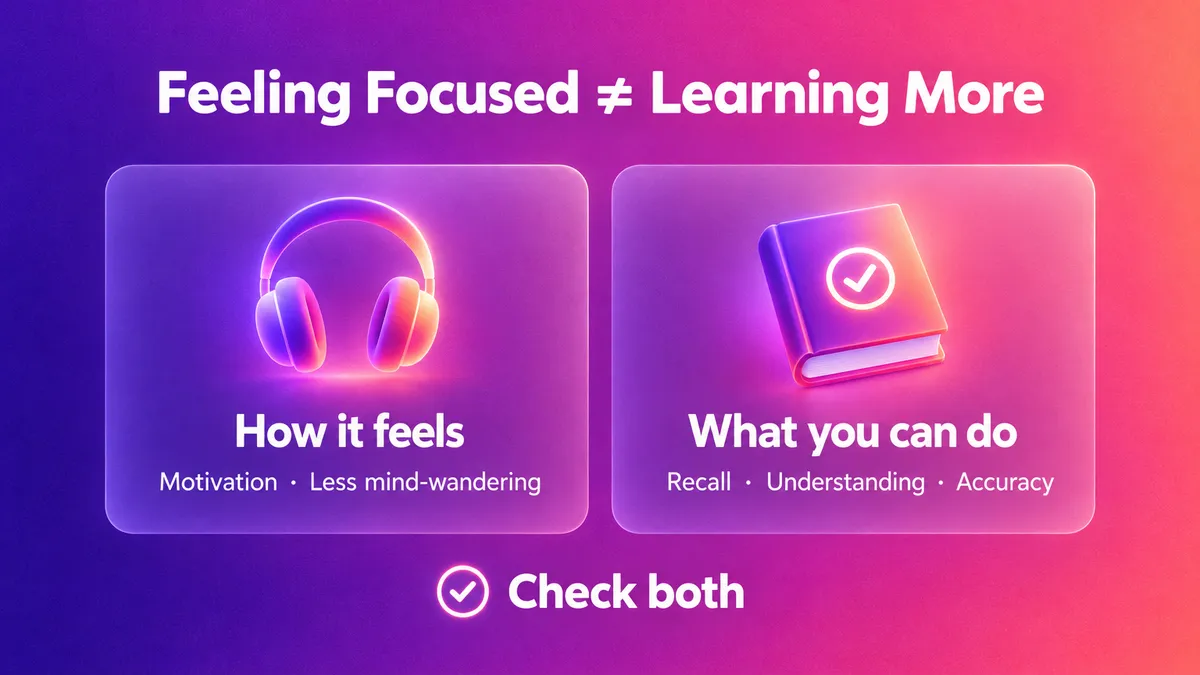
Enjoying a study session, staying on task, and remembering the material are different outcomes. A soundtrack might make work feel easier without helping you understand or recall it.
Here, the question is about background listening while studying, not learning an instrument, music education, or clinical music therapy.
What the research says about focus and learning
The clearest pattern is that the outcome being measured matters. Feeling attentive during a repetitive task is not the same as learning a chapter.
A 2022 systematic review covering 95 articles and 154 experiments found no effect of background music in many comparisons. Across the findings, though, music generally had a detrimental effect on memory and language-related tasks, and music with lyrics tended to be more disruptive than instrumental music. The review also found a generally detrimental pattern for difficult tasks, but not easy ones.
Individual experiments help explain why both enthusiastic claims and blanket warnings miss important details:
| Research | What it found | What it does not establish |
|---|---|---|
| Kiss and Linnell, 2021: 40 students who already used background music | Preferred music increased self-reported task-focus and reduced mind-wandering on a simple sustained-attention task. Reaction time did not significantly improve. | Better learning, or the same benefit for people who do not normally work with music. |
| Souza and Barbosa, 2023: memory, reading, and arithmetic tasks | Music with lyrics reduced verbal and visual recall versus silence. Reading accuracy was better with instrumental than lyrical music. Instrumental lo-fi had no clear performance advantage over silence; arithmetic showed no clear effect. | That lo-fi improves studying, or a conclusive reading advantage for either music condition over silence. The tracks also differed in ways beyond lyrics. |
| De Francesco and colleagues, 2025: 26 adults in a car-like laboratory setting | Slow-beat music improved selected visual-attention measures and subjective concentration and relaxation during a short attention test. | Better lesson learning, exam results, or grades, or an ideal tempo for studying. |
These studies answer different questions. Detecting a visual target, reporting fewer wandering thoughts, and recalling words are not interchangeable measures of “focus.” The 2025 experiment, for example, used an attention task in a simulated car interior, not a study session or a driving test.
The practical interpretation is modest: if music makes starting or tolerating a task easier, that can be useful. But it is not, by itself, evidence that you will remember more afterward.
Check both sides: motivation and distraction on one side; recall, understanding, and accuracy on the other. A soundtrack can feel helpful without improving what you learn.
When to try music, and when to start with silence
Choose your starting point based on the work, not just the genre. These are practical starting points, not proven prescriptions for every learner.
| Study task | Starting point to try | What to watch for |
|---|---|---|
| Reading difficult material | Start with silence. If you prefer background sound, compare it with quiet music for reading, an optional low-melody instrumental choice that becomes quieter as it plays. | Rereading, missing connections, or losing the thread of an argument. |
| Drafting an essay | Silence, especially when forming a difficult argument. | Following the song’s words instead of finding your own. |
| Memorizing vocabulary, definitions, or new facts | Silence, judged by later recall. | Enjoying the session but struggling to retrieve the material afterward. |
| Familiar math practice | Compare instrumental music with silence. | More errors, skipped steps, or speed without accuracy. |
| Learning a new math method or tackling a hard problem | Silence as a baseline. | Difficulty holding the steps or reasoning together. |
| Arranging notes or setting up a study space | Preferred music, if it makes preparation more engaging. | Preparation turning into a long listening session instead of actual study. |
Lyrics add another stream of words to process. While you read or write, the song gives your attention language that has nothing to do with the task. Removing lyrics avoids that particular problem, but instrumental music can still pull you away through its melody, rhythm, or changes.
Lo-fi is therefore an option, not a learning enhancer by definition. In the 2023 experiment above, students sometimes perceived instrumental music as beneficial even though it did not clearly improve performance over silence.
If you try music, begin with quiet, unobtrusive sound. For reading, avoid making fast, loud, or attention-grabbing music your first experiment. There is no need to chase an exact volume, frequency, or beats-per-minute target.
Preference matters because the sound needs to be tolerable enough to leave on. The useful question is whether the work stays understandable and accurate while it plays.
Does classical music help you study? The Mozart effect explained
Classical music is an instrumental option to try if it stays in the background. But there is no established special advantage that makes Mozart a reliable study aid.
The original 1993 report behind the Mozart effect concerned a short-lived improvement on spatial-reasoning tasks after listening to Mozart. As a 2001 historical review explains, the claim was narrow, not an improvement in general intelligence.
Three distinctions matter:
- After listening is not during studying. The original question was not whether background Mozart helps you learn course material.
- Spatial reasoning is not general intelligence or retention. Doing better on a particular spatial test does not establish better memory or grades.
- Listening is not musical training. Research about learning to play an instrument answers a different question.
Later evidence also challenged the idea of a special Mozart benefit. In a 2010 announcement from the University of Vienna, researchers described their meta-analysis of 39 studies. It did not establish a Mozart-specific benefit for spatial performance.
Enjoyment or relaxation can be enough reason to put classical music on. Judge it by the same standard as other instrumental music: whether it leaves enough attention for the work.
Does music help you study with ADHD?
Music may help some students with ADHD on some tasks, but there is no single sound or listening rule that works for everyone.
A 2025 systematic review of ADHD and music reported promising listening findings in areas including arithmetic and reading. In one reading study, calm music, with or without lyrics, helped children with ADHD more than rhythmic music; a separate study found that music worsened performance on harder reading tasks.
Most listening evidence concerned children or adolescents, leaving adult academic benefits uncertain. Small samples and differences in diagnoses, music, and medication status also limit firm conclusions.
Ordinary background listening, structured music therapy, and active musical training are different activities, so their findings need to be considered separately.
For everyday studying, compare the same kind of task with music and silence. Notice both whether getting started feels easier and whether your answers or recall stay accurate. Stop or switch if the sound becomes distracting. For demanding text, start with silence; if you want background sound, compare a calmer option rather than assuming livelier music is the better fit.
For task-starting, you could compare music for ADHD focus, a livelier instrumental option, with silence. It may not suit everyone, was not tested in the studies above, and is not ADHD treatment or a replacement for clinical care.
How to check whether music helps you study
A simple personal comparison can help you decide what to use for a particular task. This is a practical check, not a validated method.
- Pick comparable work. Choose two similar chunks of material or sets of problems. Avoid comparing easy revision with a completely new topic.
- Change the sound, not everything else. Use similar-length study blocks in the same setting, one in silence and one with quiet instrumental music. Keep phone interruptions and other changes to a minimum.
- Check learning with the material closed. After each block, explain the main ideas from memory or answer comparable questions. For math, compare correct answers and types of errors, not just speed. Check retained understanding again later when feasible.
- Record feelings and results separately. Note motivation, distraction, and willingness to continue alongside recall, comprehension, or accuracy. “Felt focused” and “remembered more” belong in different columns.
- Try again with the order reversed. On another occasion, begin with the other listening condition. Material difficulty and practice can influence the result, so look for a pattern across sessions.
The decision rule is straightforward: if music helps you begin and the work stays accurate, it may be useful for that task. If recall drops, rereading increases, or listening becomes the main activity, turn it down or off.
You can also use music before a session or during a break, then study in silence.
Choose music for your next study session
If you want to try instrumental sound rather than silence, Taranify offers free options for different situations. These are listening experiments, not proven study aids.
- For a steadier background: Try music that helps you focus, a lyric-free instrumental option that gradually settles into a steadier background, during familiar work.
- For getting ready to study: morning music becomes brighter and faster, offering sound for getting ready or easing into a morning study routine.
Choose the sound, or silence, that lets you understand and remember the work, not simply enjoy the soundtrack.